

Introduction
Think about the last time you searched for a product on Google, clicked on a social media ad, or opened a promotional email from your favorite brand. Without realizing it, you were on the receiving end of digital marketing — one of the most powerful tools that modern businesses use to reach, engage, and convert their audiences.
The emergence of digital marketing as a tool did not happen overnight. It was a gradual, fascinating transformation driven by technological evolution, shifting consumer behavior, and the unstoppable growth of the internet. Today, digital marketing is not just an option for businesses — it is an absolute necessity.
This complete guide walks you through the origins, evolution, channels, strategies, and future trends of digital marketing. Whether you are a seasoned marketer or a curious beginner, this resource is designed to give you a deep, practical understanding of how digital marketing emerged and why it continues to redefine the way the world does business.
1. What Is Digital Marketing as a Tool?
At its core, digital marketing refers to any form of marketing that uses electronic devices or the internet to connect businesses with their target audience. Unlike traditional marketing, which relied on print media, TV commercials, and physical billboards, digital marketing operates through online channels — making it more flexible, measurable, and cost-efficient.
According to Wikipedia’s overview of digital marketing, it encompasses all marketing efforts that use an electronic device or the internet, spanning strategies such as search engine optimization, content marketing, social media, and more.
Core Components of Digital Marketing
Digital marketing as a tool is not a single strategy — it is an ecosystem of interconnected channels and techniques. The most widely used components include Search Engine Optimization (SEO), Pay-Per-Click Advertising (PPC), social media marketing, email marketing, content marketing and blogging, affiliate marketing, influencer partnerships, and marketing automation tools.
Each of these components serves a different purpose but works best when integrated into a unified online marketing strategy. Together, they help businesses build brand awareness, generate qualified leads, nurture customer relationships, and ultimately drive sales and conversions.
2. The Historical Background: Before Digital Marketing
To truly appreciate the emergence of digital marketing as a tool, it is important to understand what marketing looked like before the internet changed everything.
For most of the 20th century, businesses depended heavily on traditional advertising. Newspapers, radio broadcasts, television commercials, and printed flyers were the primary means of communicating with potential customers. These methods had undeniable reach — TV ads could speak to millions of viewers simultaneously — but they came with serious limitations.
The Key Limitations of Traditional Marketing
First, traditional marketing was expensive. Buying prime-time TV slots or full-page newspaper spreads required significant budgets that were mostly out of reach for small and mid-sized businesses. Second, the results were difficult to measure accurately. A business could run a billboard campaign for months without ever knowing exactly how many people saw it, how many acted on it, or what the actual return on investment looked like.
Third, and perhaps most critically, traditional marketing was a one-way conversation. Businesses pushed their message out to consumers with no real way to receive feedback, engage in dialogue, or personalize the content. This gap between brands and their audiences was the very void that digital marketing was built to fill.
3. The Emergence of Digital Marketing: A Historical Timeline
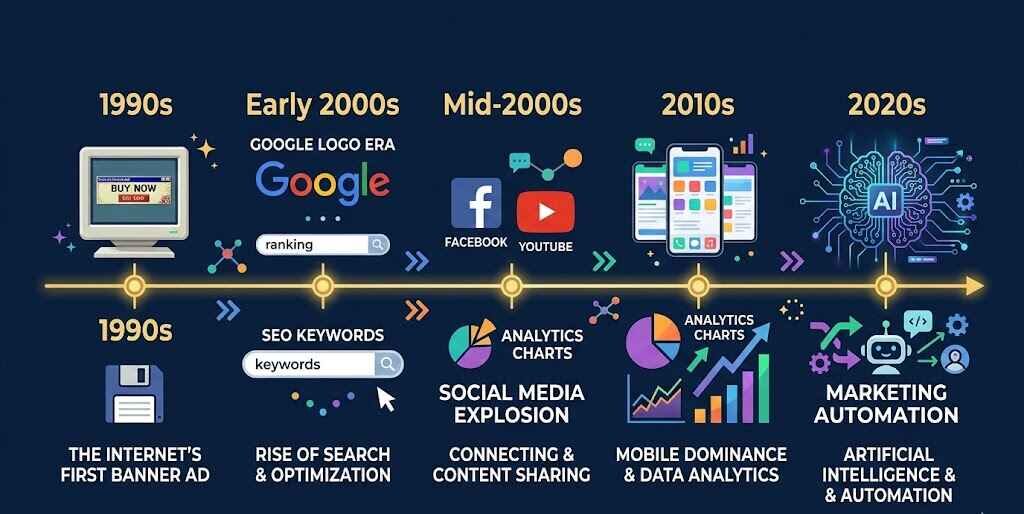
The story of digital marketing is closely tied to the development of the internet itself. Here is a closer look at how this remarkable transformation unfolded over the decades.
1990s — The Internet Era Begins
The 1990s marked a turning point for global communication. As the World Wide Web became publicly accessible, forward-thinking companies began to explore its possibilities. The first clickable web banner advertisement appeared in 1994 on HotWired.com — a small, colorful rectangle that would quietly launch an entire industry. Search engines like Yahoo! and AltaVista appeared around the same time, giving users a way to navigate the growing internet. Businesses quickly realized that being visible in search results could translate directly into customers.
Early 2000s — The Rise of Google and SEO
By the early 2000s, Google had firmly established itself as the dominant search engine, and the concept of Search Engine Optimization (SEO) had entered the mainstream business vocabulary. Companies began investing in keyword research and on-page optimization to earn higher rankings. Google AdWords — now known as Google Ads — launched in 2000, introducing pay-per-click advertising and giving businesses a way to reach customers based on what they were actively searching for. This was a revolutionary shift from interruption-based advertising to intent-based marketing.
Mid 2000s — Social Media Changes Everything
Between 2004 and 2008, the landscape transformed dramatically with the arrival of Facebook, YouTube, and Twitter. These platforms gave consumers a voice and created new, direct lines of communication between brands and their audiences. Social media marketing quickly emerged as one of the most powerful channels for community building, brand storytelling, and viral content distribution. Businesses that embraced this shift early gained enormous competitive advantages.
2010s — Mobile, Data, and Content Marketing
The proliferation of smartphones in the 2010s pushed digital marketing into the mobile-first era. Google’s algorithm began rewarding mobile-friendly websites, and mobile advertising spend exploded. Simultaneously, content marketing emerged as a cornerstone strategy — the idea that valuable, relevant, and consistent content could attract and retain audiences far more effectively than traditional ads. Data analytics platforms like Google Analytics became indispensable, allowing marketers to track user behavior, measure campaign performance, and make informed decisions in real time.
2020s — AI, Automation, and Personalization
Today, digital marketing is being reshaped by artificial intelligence, machine learning, and advanced marketing automation. Algorithms can now predict consumer behavior, personalize content at an individual level, and automate repetitive tasks with remarkable precision. Voice search optimization, chatbot marketing, and hyper-targeted advertising have become standard elements of modern online marketing strategies. The digital transformation of marketing is accelerating, and businesses that fail to adapt risk being left behind.
4. Why Digital Marketing Emerged as a Powerful Business Tool
The emergence of digital marketing as a strategic tool was not accidental — it was a direct response to fundamental changes in how people live, shop, and interact with brands.
Measurable Results and Real-Time Insights
Unlike a TV commercial that broadcasts to everyone, digital marketing campaigns can be tracked down to individual clicks, conversions, and revenue generated. Marketers can see exactly which ads performed, which pages attracted traffic, and where users dropped off in the buying journey. This level of visibility allows for continuous optimization and far better returns on investment.
Cost-Effectiveness for Businesses of All Sizes
One of the most significant advantages of digital marketing is its scalability. A small bakery in a local neighborhood and a Fortune 500 corporation can both run effective digital marketing campaigns — the difference lies in budget, not access. Social media profiles are free to create, SEO can be built over time with quality content, and email marketing platforms offer plans that accommodate businesses at every stage of growth.
Global Reach With Precise Local Targeting
Digital marketing as a tool gives businesses the extraordinary ability to think globally while acting locally. A campaign can simultaneously target users in specific cities, age groups, interest categories, or even income brackets. This precision targeting eliminates wasted ad spend and ensures that your message reaches the right people at exactly the right moment.
A Shift in Consumer Behavior
The average consumer now spends several hours each day online — browsing social feeds, reading product reviews, watching videos, and comparing prices. This digital consumer journey demanded a fundamental rethinking of how brands communicate. Digital marketing met consumers exactly where they already were, making it the most natural and effective way to build awareness and trust.
5. Core Digital Marketing Channels and Tools
Understanding the major channels is essential for anyone looking to harness digital marketing as a tool effectively.
Search Engine Optimization (SEO)
SEO is the practice of optimizing your website and content to rank higher on search engine results pages organically. It involves keyword research, on-page optimization, link building, technical site health, and creating content that genuinely serves users. A well-executed SEO strategy drives consistent, long-term traffic without ongoing ad spend.
Pay-Per-Click Advertising (PPC)
PPC campaigns, primarily through Google Ads and Bing Ads, allow businesses to bid on keywords and display ads at the top of search results. You pay only when someone clicks your ad, making it a highly efficient model for driving targeted traffic immediately. When combined with strong landing pages, PPC can deliver impressive returns.
Social Media Marketing
Platforms like Instagram, Facebook, LinkedIn, TikTok, and X (formerly Twitter) have become essential venues for brand communication. Social media marketing involves both organic content — posts, stories, and reels — and paid advertising. It excels at building communities, increasing brand visibility, and driving direct engagement with your audience.
Email Marketing
Despite being one of the oldest online marketing channels, email marketing remains extraordinarily effective. Personalized, well-timed email campaigns can nurture leads through every stage of the marketing funnel, retain existing customers, and generate consistent revenue. Tools like Mailchimp, HubSpot, and Klaviyo have made sophisticated email automation accessible even to small teams.
Content Marketing and Blogging
Content marketing is the practice of creating and distributing valuable, relevant content to attract and engage a clearly defined audience. Blogs, videos, infographics, podcasts, and case studies all fall under this umbrella. Great content builds authority, earns organic backlinks, and supports SEO efforts — making it one of the most sustainable digital marketing investments a business can make.
Affiliate and Influencer Marketing
Affiliate marketing allows businesses to partner with content creators who promote their products in exchange for a commission on sales. Influencer marketing takes this a step further by leveraging the trust and reach that social media personalities have built with their audiences. Both models deliver authentic social proof that traditional advertising simply cannot replicate.
6. The Role of Data and Analytics in Digital Marketing
One of the defining characteristics of digital marketing as a tool is the sheer volume of data it generates — and the ability to act on that data intelligently.
Platforms like Google Analytics, SEMrush, and HubSpot give marketers a window into how users are finding their websites, what content they are consuming, how long they are staying, and where they are leaving. Key performance indicators such as click-through rates (CTR), bounce rates, conversion rates, and customer acquisition costs become the language of effective digital marketing decision-making.
Data-driven marketing does not just improve campaign performance — it fundamentally changes the way businesses understand their customers. When you know what your audience is searching for, what problems they need solved, and what content resonates with them, every marketing decision becomes sharper and more strategic.
7. Challenges That Came with the Emergence of Digital Marketing
For all of its benefits, the emergence of digital marketing has not been without challenges. Understanding these obstacles is important for any marketer aiming to build a sustainable online strategy.
Content Saturation and Information Overload
As more businesses poured resources into content marketing and online advertising, the digital space became incredibly crowded. Standing out in a sea of blog posts, social media updates, and email newsletters requires genuine creativity, deep audience understanding, and consistent quality. The businesses that win in today’s environment are those that create content with real value rather than simply adding to the noise.
Data Privacy and Regulatory Compliance
Growing concerns about data privacy have led to significant regulatory changes, including the General Data Protection Regulation (GDPR) in Europe and similar frameworks around the world. Marketers must now navigate a more complex landscape around cookie usage, data collection, and user consent. These changes have required a fundamental rethinking of how audience data is gathered and used.
Algorithm Changes and Platform Dependency
Every major digital platform — Google, Facebook, Instagram — regularly updates the algorithms that determine who sees what content. These changes can dramatically affect organic reach and ad performance overnight. Savvy marketers know the importance of diversifying their digital presence across multiple channels rather than relying entirely on a single platform.
8. The Future of Digital Marketing as a Tool
The digital marketing landscape continues to evolve at a pace that would have seemed impossible just a decade ago. Several trends are shaping the next chapter of this industry.
Artificial Intelligence and Machine Learning
AI is already transforming everything from content creation and personalization to programmatic advertising and customer service chatbots. In the coming years, AI-powered tools will become even more central to digital marketing operations, helping businesses predict customer needs, automate complex workflows, and deliver hyper-personalized experiences at scale.
Voice Search and Conversational Marketing
With the widespread adoption of smart speakers and voice assistants, voice search optimization is becoming an increasingly important piece of the SEO puzzle. Brands are also embracing conversational marketing — using chatbots and messaging apps to engage customers in real-time, two-way dialogue that feels natural and immediate.
Augmented Reality and Immersive Experiences
Augmented reality (AR) is opening up new creative possibilities for digital marketing. Retail brands are allowing customers to virtually try on products, while real estate companies are offering immersive virtual property tours. These technologies push the boundaries of how digital marketing can create memorable, engaging brand experiences.
9. How to Get Started with Digital Marketing Today
If you are ready to put these insights into practice, here is a practical framework for building your digital marketing strategy from the ground up.
Start by clearly defining your target audience — understand who they are, what platforms they use, and what problems they need solved. Then set specific, measurable goals for your campaigns, whether that is growing website traffic, increasing leads, or boosting e-commerce sales.
Choose two or three core channels to focus on initially rather than spreading your resources too thin. For most businesses, a combination of SEO, social media marketing, and email marketing offers a strong foundation. Invest in understanding analytics from day one — knowing how to read your data will be one of your most valuable skills as a digital marketer.
Finally, embrace the mindset of continuous learning. Digital marketing as a tool evolves constantly, and staying current with trends, algorithm updates, and emerging platforms is what separates good marketers from great ones.
Conclusion
The emergence of digital marketing as a tool represents one of the most significant transformations in the history of commerce. From the first banner ad of the mid-1990s to today’s AI-powered personalization engines, this journey reflects both the ingenuity of marketers and the ever-changing expectations of consumers.
Digital marketing has democratized opportunity — giving small businesses the ability to compete with larger corporations, giving consumers more power and choice than ever before, and giving brands entirely new ways to build trust and loyalty. Understanding its history, mastering its tools, and adapting to its future trends is no longer optional for businesses that want to grow and thrive.
Whether you are just beginning your digital marketing journey or looking to refine an existing strategy, the core principles remain constant: know your audience, deliver genuine value, measure everything, and never stop learning. In a world where nearly every purchasing decision begins with an online search or a scroll through a social feed, digital marketing is not just a tool — it is the foundation of modern business growth.
